
Note: The above is a picture because I didn't realize that blogger doesn't allow copy/pasting from word. Also, click the picture to make it larger.
Now, just what is the Negative Exponent Law? Defined scientifically (or mathematically I suppose) it is: a nonzero base raised to a negative exponent is equal to the reciprocal of the base to the positive exponent.
Quite a mouthful, eh? Well, don't you worry, never fear, Robin Hood will soon be here... Ahem... Until he does I'll just continue on with the class, shall I?
Hm... Now where was I... Ah yes! Mr B's demonstration of this law... Well, first, I think I'll give a simpler definition considering the one above can be quite confusing... Relatively speaking, the Negative Exponent Law states that when you have a base that isn't zero and you're raising it to a negative exponent, it is equal to the reciprocal of the fraction that you get. (Here's a picture to make it much simpler).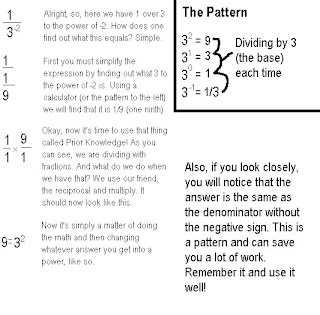 Alright. This concludes the lesson on Grade 10/11 stuff... Yeah... We're learning advanced stuff because we're "The Class"... Or, Mr B just wants us to... I amen't sure... Anyway, Robin Hood should be coming right about now to deliver his- Ah! Here he is (took him long enough)!
 Thank you, "Robin" for your very...er....informative definition of the Negative Exponent Law. I was kind of hoping you'd say something more along the lines of it dealing with patterns and fractions as I demonstrated above but, oh well. Beggars can't be choosers, until Robin Hood gives them money! Harhar... I made a funny (and a rhyme)!
*drumroll* And now, the moment you've all been waiting for, HOMEWORK! *trumpet fanfare*
Textbook Pgs. 118-119 (All questions)
Workbook Chapter 3.4
Mathlink Chapter 3.4 (Separate Sheet, not in Textbook)
 So, you may be asking why Ned is here, aren't you? Well Ned is here for two things. The first is to tell you that you "should" have lots of stuff in your foldable (you can still be working on it) and the second is to recite a poem about dividing decimals. Yes, I am serious... Just listen...


Well, that's about it. I will now list the homework in BOLD BRIGHT COLORS, for those who don't want to read my entire scribe.

