Showing posts with label symmetry. Show all posts

Scribe Post for October 16, 2009

Saturday, October 17, 2009
Hey, 9-05. Today in class, we had a math test. It was mostly on surface area and bit on symmetry too. Today I will be showing you how to do questions on the test we had. One thing is, that you really need to know your formulas for all the shapes and also know when to use them.


These question are examples of what you need to know in order to answers the questions right. But they are not same as the test. The reason for this is that not everybody has taken the test yet and I don't have the test in front of me so I don't remember the exact measurements that were on the test.

These are some examples:


To figure the cylinder you need to know the formula for a cylinder.
Which is:
H=15
Radius=3
S.A. = 2πr²+2πrh

= 2π(3²)+2π(3)(15)

= 2π(9)+2π(45)

= 2(28.27)+2(141.37)


= (56.54)+(282.74)


= 339.28cm²


This is the formula for a rectangular prism
2(lw)+2(lh)+2(hw)

2(4)(2)+2(4)(1)+2(1)(2)


2(8)+2(4)+2(2)
16+8+4
=28


Thanks for reading.
The homework is on the grade 9 homepage.
Please comment

Elegant Algabraic Expressions

Sunday, October 11, 2009
Hi 9-05! Mr. B has assigned us all some homework for the weekend. We're supposed to answer a few questions about surface area, so I'm going to answer mine in the most blunt way possible.

WHAT IS THE MOST ELEGANT ALGEBRAIC EXPRESSION FOR ...

... surface area of a cube?

Well, you see, a cube has 6 faces and each of those 6 faces are equal. Since each of those faces are equal, whatever length one side is would be squared.


i.e. 3 by 3 cube

The most elegant algebraic expression for a cube would be 6s²


Example:
SA= 6s²
SA= 6(3²)
SA= 6(9)
SA= 54u²


... surface area of a rectangular prism?
Being a prism, a rectangular prism has 6 faces. Although, unlike a cube, a rectangular prism does not have all equal sides. A particularly good way to see how to calculate surface area of a rectangular prism wold be to see how its net looks like.

Seeing the measurements is a good way of seeing what parts of the rectangular prism have plane symmetry. The net above, however, is not the only way to portray the net of a rectangular prism. It's actually kind of confusing, but the picture itself is quite clear.

The most elegant algebraic expression for a rectangular prism is SA= 2(lw) + 2(hw) + 2(hl)

Example:
h=5
l=4
w=2

SA= 2(lw) + 2(hw) + 2(hl)
SA= 2(4)(2) + 2(5)(2) + 2(5)(4)
SA= 2(8) + 2(10) 2(20)
SA= 16 + 20 + 40
SA= 76u²


*remember to always add in the u² after your answer because we're dealing with 3D shapes

... surface area of a cylinder?
I'm sure all of you are familiar with how we learned this formula last year, where we just found the area of the two circles and the rectangle of the cylinder and added them all together. As you all should know, we learned a different way to calculate surface area of a cylinder.
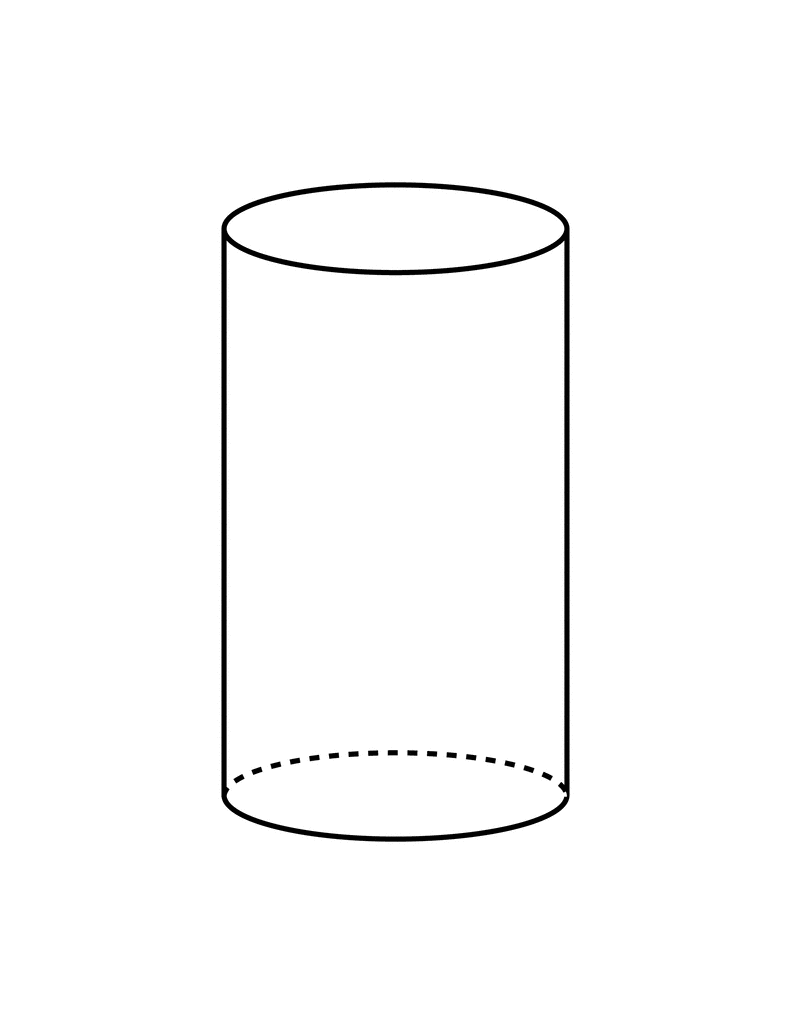
During one of our math classes we learned that the circumference of the circle of the cylinder is equal to the width of its rectangle. To test this out just roll up a rectangular peice of paper and look at the circle and see that its width goes all around the circle, or rather the circumference.

Since we're calculating surface area of a cylinder, we know we need to have the formula for area of two circles. The formula for a circle is πr², so the formula for two circles would simply be 2(πr²). Now we need to find the area of the rectangle of the cylinder. We know that the width is equal to the circumference of the circle, and area of a rectangle is (lw) so we multiply 2πr by height, which is like the length of a rectangle.
So the most elegant algebraic expression for a cylinder is SA= 2(πr²) + 2πrh


COMPOSITE SHAPES
I actually didn't know what a composite shape was at first, but I found that it's a figure that can be divided into two or more shapes. This was what Mr. B has been telling us about for the past couple of days, but I didn't know what the technical term was then.
I think the best way to calculate the surface area for composite shapes is to look at the figure from all angles and add it all up because this can apply to all composite shapes. Some composite shapes have holes and spaces in them and this can make calculating surface area for composite shapes confusing.

HOW DOES SYMMETRY HELP US SOLVE SOME OF THESE SURFACE AREA PROBLEMS?
A figure usually has 6 faces; 3 sets of 2 symmetrical faces. Plane of symmetry are imaginary lines drawn on polyhedrons to show that both sides are symmetrical. Imagine these lines as if they cut right through the polyhedron. Symmetry helps us solve for surface area because if we see one face we know that on the opposite side there should be another face just like it. This rule usually applies for regular shapes, however. Understanding symmetry allows us to see that if one side has a measurement of so-and-so, then the other side should have that same length as well.

WHAT HAPPENS IF A PART OF ANY OF THESE SHAPES IS MISSING? HOW DO I FIND SURFACE AREA THEN?
Most polyhedrons usually have plane of symmetry. We can use plane of symmetry to find the missing part of a shape by finding its symmetrical other.
Example of Plane of Symmetry:

I hope in one way or another this has helped! Please feel free to comment! :)

Why 360?

Sunday, October 4, 2009
Have you ever wondered why does a circle have 360 degrees? Well I haven't really thought about it, I just went with it until the question came up in math class and then I found out.

It started out with the Babylonians and they had a base 60 number system. We use this base 60 number system in our time like 60 minutes in an hour and 60 seconds in a minute. But we have a base 10 number system. The base 60 system is called the Sexagesimal system. The Babylonians took their base and multiplied it by 6. And they came up with 360.


360 was very close to how many days are in a year. There are actually 365.25 days in a year. The Babylonians had a calendar that consisted of 360 days a year. The Babylonians did research and watched the sky and the sun and they realized that it took at least 360 days to go though the whole process. They were very close but they thought the Sun went around the earth in 360 days. But the earth goes around the sun in 365 days.

There are 360 different sunset points of entry on the horizon during a calendar year (to the naked eye). 90 points / days between Winter Solstice to Equinox, Equinox to Summer Solstice, Summer Solstice to Equinox and then Equinox to Winter Solstice. And that is basically all 4 seasons.


The base 60 system is also very common and is a common number too. Many numbers go into 60. Like the numbers 1, 2, 3, 4, 5, 6, 10, 12, 15, 20, 24, 30, and 60.


The numbers from the base 60 number system looks like this.


(sorry if the picture is blurry just go to this site if you cannot see)
Thanks for reading my post! I hope you understand why now! Please leave a comment.

Why 360?

Lots of people ask the same question. Why 360 degrees in a circle? Well it all started with the Babylonians. They used a base of 60, rather then 10 like we do. This system was called the Sexogonal System.


Another reason they used 360, was because 360 is divisible by A LOT of numbers for example 1, 2, 3, 4, 5, 6, 8, 9, 10, 12, 15, 18, 20, 24, 30 and more. The Babylonians calender also was made up of 360 days, when the earth makes a complete rotation, a circle, so to the Babylonians it made sense for a circle to be 360 degrees.


So I hope that my post helped you understand 360. If I missed anything please comment.

Why use 360?

Saturday, October 3, 2009
Most of us have been wondering why we use 360 degrees for a full circle. Well, blame the Babylonians. Just kidding! The Babylonians used 60 as their base. While, we, use 10 as our base. So, what the Babylonians did is that they multiplied their base (60) by 6 (the number of sides in a hexagon). This system is called the sexagesimal system.


I would say that we use 360 because, it has a lot of advantages. Like for example, it's one of the few numbers that have many factors. These are all the factors:1, 2, 3, 4, 5, 6, 8, 9, 10, 12, 15, 18, 20, 24, 30, 36, 40, 45, 60, 72, 90, 120, 180, 360 . Having many factors makes 360 a very nice unit to divide a circle into equal parts. Also, we use it in calendars, and fractions. 360 is a very popular number.
This is an example: earth's revolution around the sun is approximately 360 days (Babylonians had 360 days a year).


So, I hope you understand a bit better of why we use 360. If I missed anything, or if you have any suggestions, fell free to comment. :)

Scribe for October 1, 2009

Thursday, October 1, 2009
Hello, 9-05. Today in class, we had a math test. Some of the questions on that test was similar to the test last time. There are some questions I had trouble with on the test. Like, the one with a card (10 of diamonds). It was asking what type of symmetry is shown on the playing card, and explain. I was going to put it had line symmetry, but, I tried drawing lines of symmetry. Though, it didn't work. Then I remembered, it could have rotation symmetry. Here it is:


The image has an order of rotation: 2. The angle of rotation is 180 degrees. So, therefore it has rotation symmetry.


I'm going to show you another question from the test. Here it is:
Find the angle of rotation for the following image:


The angle of rotation is: 60 degrees.

Those are two of the questions that was on the test.

We had a few homework for today

1) Provide an algebraic formula for finding the surface area of a rectangular prism.

2) Provide a formula for finding the surface area of a cylinder.

*Then, when we come to class, we should be able to explain, make a net, and be able to talk about the symmetry of the shapes. (for rectangular prisms and cylinders)

3) Write in our journals.

4) Last but not least, comment on my post! :)

The next scribe is Aleiah. The homework is due. next class. So you better get going!