Why 360?

Sunday, October 4, 2009
Do you know why 360 degrees is a full circle? The reason why we use the number 360 is because it started with the Babylonians.


Now in the present, we use the base of 10, when once in the past, the Babylonians used the base of 60. That system that they used was called the Sexogonal System. The Babylonian also made a calendar that had 360 days because they believed that the earth has a full rotation after every 360 days.


Also, if you haven't noticed, 360 is a very handy number. It can be divided by alot of numbers. It has alot of factors such as: 1, 2, 3, 4, 5, 6, 8, 9, 10, 12, 15, 18, 20, 24, 30, 36, 40, 45, 60, 72, 90, 120, 180, 360.

I hope you guys learnt something number about why we use the number 360. Please comment if you would like to add something to my post (:

Why 360?

Lots of people ask the same question. Why 360 degrees in a circle? Well it all started with the Babylonians. They used a base of 60, rather then 10 like we do. This system was called the Sexogonal System.


Another reason they used 360, was because 360 is divisible by A LOT of numbers for example 1, 2, 3, 4, 5, 6, 8, 9, 10, 12, 15, 18, 20, 24, 30 and more. The Babylonians calender also was made up of 360 days, when the earth makes a complete rotation, a circle, so to the Babylonians it made sense for a circle to be 360 degrees.


So I hope that my post helped you understand 360. If I missed anything please comment.

Why use 360?

Saturday, October 3, 2009
Most of us have been wondering why we use 360 degrees for a full circle. Well, blame the Babylonians. Just kidding! The Babylonians used 60 as their base. While, we, use 10 as our base. So, what the Babylonians did is that they multiplied their base (60) by 6 (the number of sides in a hexagon). This system is called the sexagesimal system.


I would say that we use 360 because, it has a lot of advantages. Like for example, it's one of the few numbers that have many factors. These are all the factors:1, 2, 3, 4, 5, 6, 8, 9, 10, 12, 15, 18, 20, 24, 30, 36, 40, 45, 60, 72, 90, 120, 180, 360 . Having many factors makes 360 a very nice unit to divide a circle into equal parts. Also, we use it in calendars, and fractions. 360 is a very popular number.
This is an example: earth's revolution around the sun is approximately 360 days (Babylonians had 360 days a year).


So, I hope you understand a bit better of why we use 360. If I missed anything, or if you have any suggestions, fell free to comment. :)

Why 360°?

Why 360° Degrees

Hello to rooms 9-05 and 9-06,

Today the question I am answering is why 360° Degrees? Why not another number you ask? Well the answer to that question is very simple.


The main reasons for choosing the number 360 are


The Babylonians created their number system called the sexagesmal number system. Which uses
a base of 60 instead of what we use now, which is a base of 10.


Another reason for picking the number 360 is that it have many divisors, actually it has 24. They are 1, 2, 3, 4, 5, 6, 8, 9, 10, 12, 15, 18, 20, 24, 30, 36, 40, 45, 60, 72, 90, 120, 180, and 360. including 1 and its self. They chose this number because they thought if it had a lot divisors then it would work, instead of using a base of 10 which only has 4.(1,2,5,10)


360 is also a good number to divide a circle into equal parts which why it was picked. If you look around theirs a lot of example of 360, Time: 60 min. in a hour, the one everyone knows the best, the calender: which had 360 days in a year, where the earth would rotate around the sun
. Making one full year. But before we added 5 for days to the calender so we could be more accurate, the Babylonians stayed with 360.


That is why I think the number 360 was chosen. Thanks for reading my explanation on why 360 was picked!
Please leave comments, because nobody can be perfect.

Why are there 360° in a Circle?

Why 360°?
Dear rooms 9-05 and 9-06,
we have 360° in a circle because of 3 main reasons.

1) The Babylonians used a sexagesmal number system. That means that instead of using a base of 10, they used a base of 60. We go up to 9 and then we put a 1 followed by a 0 (10). A base of 60 meant that they would go up to out so called "59", then the would combine their numbers to make a "60".


2) 360 is a very easy number to divide. There are 24 factors for the number 360. Those numbers include 1, 2, 3, 4, 5, 6, 8, 9, 10, 12, 15, 18, 20, 24, 30, 36, 40, 45, 60, 72, 90, 120, 180, and 360.

3) Did you notice that there are about 360 days in a year? Meaning that it takes about 360 days for Earth to make a full rotation (orbit) around the Sun. Remember, the Babylonians had 360 day years.


I hope you understood my post and it helped. I have one thing for you to think about. Did you ever notice that there are 60 seconds in a minute and 60 minutes in an hour? 24 hours in a day? 12 months in a year? Almost everything is a factor of 360. Please comment if I missed anything or if you have any ideas.

Why 360°?

Thursday, October 1, 2009

Hello 9-05 and 9-06! So Mr. B assigned 9-05 (because we're going to be the class) to make a post explaining to 9-06 why we use 360 all the time. I hope this short and concise post will be helpful to you!

First of all, 360 is a very round and friendly number to use. It's divisible by a lot of numbers (24 to be exact). Secondly, the Babylonians were devoted to geometric figures, and they based their number system on the number 60 rather than 10 like we usually do. This number system is called the Sexogonal System. Their calendar even had 360 days and their complete cycle was divided up into 360 units. We have adapted from the Babylonians because our clocks have 60 minutes and each minute is 60 seconds.


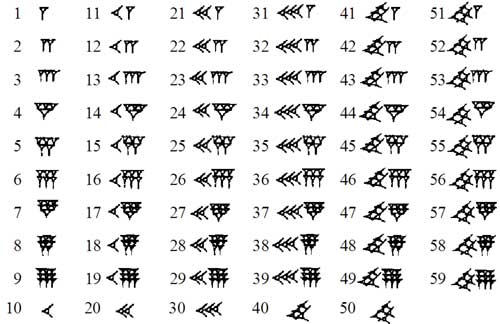
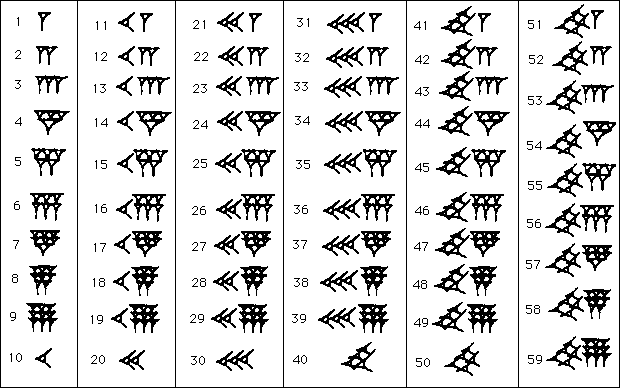
Here is an example of the Babylonian's number system.

The Babylonians thought that there were approximately 360 days in a calendar, since the Earth rotated about 1 degree around the Sun per day. So, when the Earth makes a full rotation around the Sun that would be a full circle. That's why the Babylonians used 360 to represent a full circle. Our place value is ones (1) tens (10) hundreds (100) thousands (1000) etc. because our number system is based on 10. As mentioned previously, Babylonians used the Sexagismal system. In the chart above, you can see all the symbols for each number character. I think that the 59 symbol and the 1 symbol would be the representative for the number 60, or perhaps the 50 symbol and the 10 symbol would be the representative for 60. I am not sure, because of the sites I've encountered, they were unclear about this. I think that the next place value would be something like 120 and it could be a combination of two 50 symbols and two 10 symbols or a 20 symbol, which is actually two 10 symbols. I think that an easier way to write these numerals using our number system would be 50 and 10 for 60. 50 and 50 for 100, etc.
So that is basically why we use 360̊̊ to describe a full circle. If I've missed anything, feel free to comment!


OTHER SOURCES:

Scribe for October 1, 2009

Hello, 9-05. Today in class, we had a math test. Some of the questions on that test was similar to the test last time. There are some questions I had trouble with on the test. Like, the one with a card (10 of diamonds). It was asking what type of symmetry is shown on the playing card, and explain. I was going to put it had line symmetry, but, I tried drawing lines of symmetry. Though, it didn't work. Then I remembered, it could have rotation symmetry. Here it is:


The image has an order of rotation: 2. The angle of rotation is 180 degrees. So, therefore it has rotation symmetry.


I'm going to show you another question from the test. Here it is:
Find the angle of rotation for the following image:


The angle of rotation is: 60 degrees.

Those are two of the questions that was on the test.

We had a few homework for today

1) Provide an algebraic formula for finding the surface area of a rectangular prism.

2) Provide a formula for finding the surface area of a cylinder.

*Then, when we come to class, we should be able to explain, make a net, and be able to talk about the symmetry of the shapes. (for rectangular prisms and cylinders)

3) Write in our journals.

4) Last but not least, comment on my post! :)

The next scribe is Aleiah. The homework is due. next class. So you better get going!